What to Check Before Buying a Knit Sweater
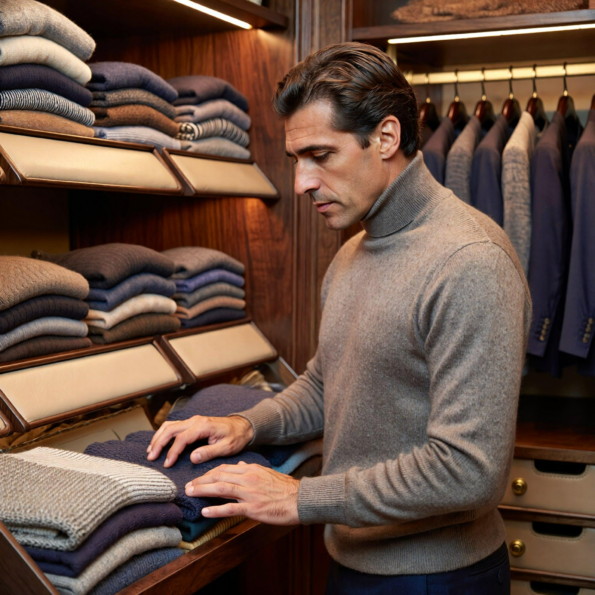
Fiber content tells you less about a sweater than most people assume. Two pieces can carry an identical fiber label and behave nothing alike, because what actually determines how a knit performs is how the yarn was spun, how densely it was knitted, and how the pieces were joined together.
Six checks, all of which can be done in under a minute, whether the sweater is in your hands or in a photograph and a measurement table.
1. Hold It Up to the Light
Stretch a section of the body gently between both hands and look toward a window. A dense knit shows light as a faint even glow through the loops. A sparse one shows daylight in distinct gaps between individual stitches.
Density is the closest proxy for how long a sweater will hold together and how warm it will actually be. A loosely knitted piece in a warm fiber often performs worse than a densely knitted one in something ordinary.
2. Check How the Yarn Was Twisted
Look closely at a single strand where it runs across the surface. A tightly twisted yarn looks like a small rope with a visible spiral. A loosely twisted one looks soft and slightly fuzzy, with fiber ends standing out from it.
Loose twist feels wonderful in the first week and pills heavily afterward, because those loose fiber ends are exactly what works free and tangles. Tight twist feels less plush at the start and keeps its surface far longer.
3. Look at How the Pieces Are Joined
Turn the sweater inside out and find the seam where the sleeve meets the body. A fully fashioned knit shows a narrow line of shaped stitches following the curve, because each panel was knitted to shape and then linked. A cut-and-sew construction shows a cut raw edge overlocked with a serged thread.
Fully fashioned costs more to make and holds its shape better, especially at the shoulder. Overlocked seams are not a fault on their own, but they are the first place a knit tends to give.
4. Test the Ribbing
Stretch the cuff and the hem ribbing open and let go. Good ribbing snaps back immediately and completely. Weak ribbing hesitates, or comes back most of the way and stops short.
This matters more than it sounds. The cuffs and the hem are what hold a sweater in position on the body, and when they go slack the whole piece starts riding and bunching regardless of how good the rest of the knit is.
5. Weigh It in Your Hands
Pick the sweater up and pay attention to what your arms tell you. A knit with substance has a weight that is noticeable without being heavy, and it drapes downward when you hold it by the shoulders rather than floating.
A piece that feels like almost nothing is usually thin, and thin knits show every ripple of whatever is underneath. A piece that feels genuinely heavy is a chunky gauge and belongs in cold rooms rather than heated ones.
6. Read the Measurements, Not the Size Letter
A letter on a label means whatever the maker decided it means. A measurement table taken from the garment laid flat means something specific. Chest across the underarm, body length from the shoulder seam, sleeve from the shoulder seam, and cuff and hem width are the numbers worth having.
Compare those against a sweater you already own and like, which is the only reference point that accounts for your actual body and your actual preference. How we describe and group the pieces we stock is set out on our About Us page, and specific sizing questions are answered on our FAQs page.
Thank you for shopping with us, and for giving a good sweater a few more seasons of wear.
- Store Name: Acaamg
- Address: 1049 Lumber Plant Rd, Lowgap, NC 27024, United States
- Digital Website: https://acaamg.com
- Customer Support Email: [email protected]
- Support Hours: Monday – Friday: 9:00 AM – 5:00 PM EST
© 2026 Acaamg. All Rights Reserved.
