How to Keep a Sweater From Losing Its Shape
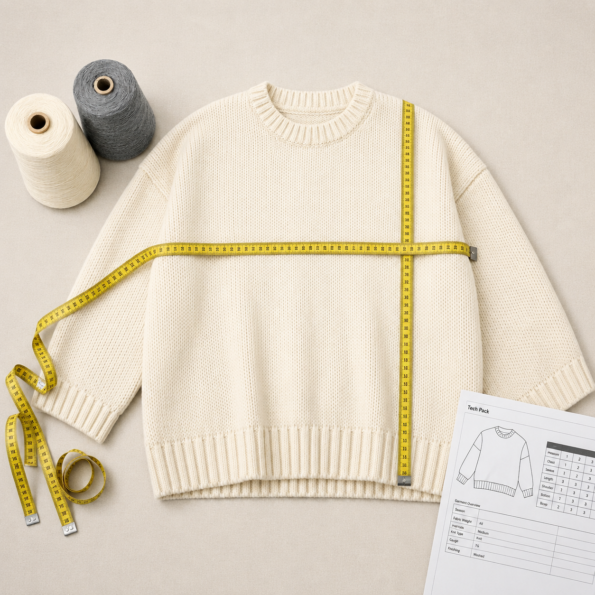
Sweaters rarely wear out. They go out of shape first, and then they get quietly retired. The body grows a hand-span longer than it was, the cuffs stop gripping the wrist, and two hard points appear at the shoulders that no amount of brushing removes. At that point the knit itself is usually still sound.
Almost all of that damage happens outside the wash. It happens on a hanger, in a drying rack, and in the ten minutes after a wash when a wet sweater is carrying several times its dry weight. Here is how to stop it.
Never Hang a Knit
A hanger concentrates the entire weight of a garment onto two narrow points at the shoulder. A woven shirt has enough structure to spread that load. A knit does not, because a knit is a grid of loops that stretches in whichever direction it is pulled and stays stretched.
Fold instead. Sleeves back, fold once at the waist, stack no more than three or four high so the bottom one is not compressed for months. If drawer space is the problem, folding on a shelf is still better than the neatest hanger.
Wash Cool and Get the Water Out Properly
Cold water on a gentle cycle handles most knitwear. Heat and agitation are what cause fibers to felt and shrink, and the two together do it faster than either alone. Turn the piece inside out so the outer face is protected from rubbing against the drum.
The moment the cycle ends is the one that matters. A wet sweater lifted by the shoulders will stretch under its own water weight before it reaches the drying rack. Gather it into a bundle, support the whole thing with both hands, and lay it on a towel. Roll the towel with the sweater inside and press. Do not wring it, because wringing twists the loop structure permanently.
Dry Flat and Block It Back to Size
Lay the sweater flat on a fresh dry towel or a mesh rack. While it is still damp, push it gently back into the shape you want: square the shoulders, ease the body back to its proper length rather than letting it sit long, straighten each sleeve, and pat the cuffs and hem back to their narrower width.
This is blocking, and it is the step that does the most work here. A damp knit holds whatever shape it dries in. A sweater that has grown too long through a season of wear can usually be walked back most of the way with one careful wash and a deliberate block.
Deal With Pilling Instead of Ignoring It
Pills are short fibers that have worked loose and tangled at the surface, and they gather where friction is highest: under the arms, along the sides where an arm swings, and across the back where a bag strap or a car seat rubs. They are a sign of use, not of a fault.
Lay the piece flat and work with a sweater comb or a fabric shaver in short strokes in one direction. Never pull a pill off by hand, because it is still attached to a working loop and pulling it takes yarn with it. Doing this once a season keeps the surface even.
Store With Air, Space, and No Light
Between seasons, put knitwear away clean. Body oils and traces of food are what attract moths, so a sweater stored dirty is a sweater at risk. Fold it into a breathable cotton bag or a box rather than sealed plastic, which traps moisture against the fiber.
Keep it out of direct light, which fades dyed yarn unevenly and often only on the side that faced the window. A cedar block or a lavender sachet in the box does no harm and may help.
Rest Between Wears
A knit needs a day off after a day on. The loops relax back toward their original dimensions once the body heat and moisture have gone, and wearing the same sweater on consecutive days interrupts that. Two pieces in rotation last considerably longer than one worn continuously.
If you want the reasoning behind how we group and describe knitwear in the first place, that sits on our About Us page. Sizing and order questions are collected on our FAQs page.
Thank you for shopping with us, and for giving a good sweater a few more seasons of wear.

- Store Name: Acaamg
- Address: 1049 Lumber Plant Rd, Lowgap, NC 27024, United States
- Digital Website: https://acaamg.com
- Customer Support Email: [email protected]
- Support Hours: Monday – Friday: 9:00 AM – 5:00 PM EST
© 2026 Acaamg. All Rights Reserved.
