Wearing a Cardigan Open, Half Done, or Closed
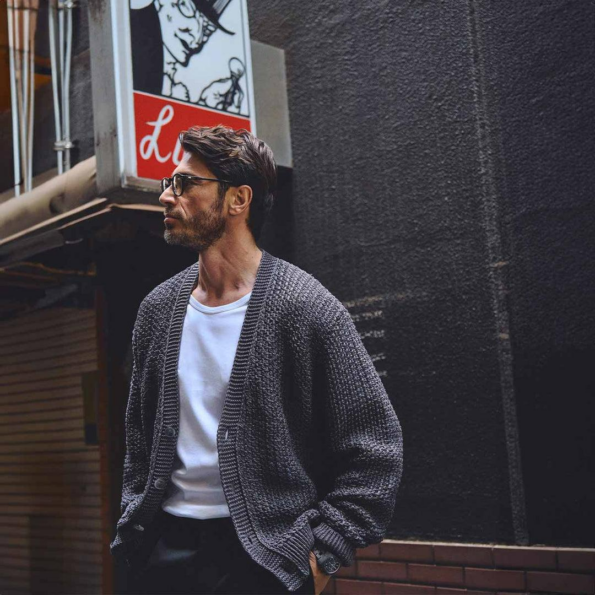
A cardigan is the only knit that comes with a dial on the front. The same garment reads three different ways depending on how many buttons are done, and most people only ever use one of those settings. Here is what each one actually does.
Fully Open: The Vertical Line
An open cardigan creates two vertical panels with a gap running down the middle. The eye follows that gap, which lengthens the whole silhouette and narrows the torso visually. It also puts whatever is underneath on display, so the shirt or tee becomes half of the outfit rather than a hidden layer.
This setting rewards a layer underneath that can carry it: a shirt with a clean collar, a plain tee in a color that contrasts with the knit, or a polo. It works least well over something busy, because the eye then has three competing things to look at in a narrow strip.
Half Done: The Compromise Nobody Uses
Fastening the middle two or three buttons and leaving the top and bottom open is the most useful setting and the least used one. It marks a waist, keeps some of the vertical line, and closes the chest without shutting the collar in.
The rule of thumb is to fasten from just below the sternum to just above the hip. Leave the bottom button undone so the hem can move when you sit down, and leave the top one or two undone so the collar of whatever is underneath stays visible. A cardigan buttoned from the very top down reads stiff almost every time.
Fully Closed: A Sweater With Options
Buttoned all the way, a cardigan does what a pullover does, with one advantage: you can undo it. That is worth remembering on a day with a long car journey at one end and an overheated room at the other.
The thing to watch when closing a cardigan completely is the button placket. On a fine gauge it lies flat and disappears. On a heavier knit it adds a visible ridge down the front, which is fine on its own but bulks up noticeably under a jacket. If a cardigan is going to spend the day closed under something else, reach for the finer one.
Matching the Setting to the Neck Underneath
The shape of the cardigan opening and the neckline underneath either agree or argue. A deep V opening over a crew-neck tee frames the neckline and reads deliberate. The same V over a high round collar crowds it. A shawl collar wants something simple underneath, because the collar is already the strongest shape in the outfit.
A quick check in the mirror: if you can see three distinct necklines stacked, one of them is doing nothing and should come out.
Sleeves, Cuffs, and the One Thing to Avoid
Pushing cardigan sleeves up the forearm is a legitimate setting of its own and shifts the whole outfit toward relaxed. Do it by folding the cuff back on itself rather than bunching the sleeve, which stretches the ribbing and leaves it slack for good.
The one setting to avoid entirely is a cardigan worn closed with the hem hanging well below a jacket. If a jacket is going over the top, the knit underneath should end at or above the jacket hem.
Why the Front Opening Is the Point
Every setting above exists because the front opens, and that is the whole reason cardigans and pullovers are stocked as two separate groups here rather than one. The thinking behind that split is on our About Us page, and each listing names which group it belongs to before anything else. Sizing questions are answered on our FAQs page.
Thank you for shopping with us, and for giving a good sweater a few more seasons of wear.
- Store Name: Acaamg
- Address: 1049 Lumber Plant Rd, Lowgap, NC 27024, United States
- Digital Website: https://acaamg.com
- Customer Support Email: [email protected]
- Support Hours: Monday – Friday: 9:00 AM – 5:00 PM EST
© 2026 Acaamg. All Rights Reserved.
